Smil, Unit 69-70, Dockside Outlet Shopping Centre, Maritime Way, St Mary's Island, Chatham, ME4 3ED


Smil, Unit 69-70, Dockside Outlet Shopping Centre, Maritime Way, St Mary's Island, Chatham, ME4 3ED


Have you recently lost a tooth? If you have, you’ll notice differences when eating, speaking or even when smiling in photographs. Fortunately, modern dentistry offers several reliable ways to restore both the appearance and function of your smile.
Two of the most common options are dentures and dental implants. While both are designed to replace missing teeth, they work in very different ways and are suited to different situations.
Understanding how each option works can make it much easier to decide which approach might be right for you. Below, we’ll explore the key differences between dentures and dental implants, and when each option may be recommended.
When a tooth is lost, the effects go beyond the gap you can see. Neighbouring teeth may begin to shift into the space, which can affect your bite and make cleaning more difficult. Over time, the jawbone in the area can also begin to shrink because it is no longer stimulated by a tooth root.
This is why our dentists usually recommend replacing missing teeth where possible. Restoring the gap helps maintain the structure of your smile, supporting comfortable chewing.
Dentures and dental implants are two effective ways of achieving this.
Dentures are removable appliances designed to replace several missing teeth or an entire arch of teeth. They have been used successfully in dentistry for many decades.
Dentures are typically made from acrylic or a combination of acrylic and metal. Artificial teeth are set into a gum-coloured base that sits comfortably on top of the gums.
There are two main types of dentures:
Full dentures
Full dentures replace all of the teeth in either the upper or lower jaw. They rest directly on the gums and are carefully shaped to fit your mouth.
Modern dentures are far more natural-looking than many people expect. They are designed to restore the appearance of your smile while supporting facial structure and lip shape.
Partial dentures
Partial dentures are used when some natural teeth remain. They attach to neighbouring teeth using small clasps or precision fittings.
This allows them to fill the gaps while keeping the remaining natural teeth in their correct positions. Because dentures are removable, they can be taken out for cleaning and while sleeping.
A dental implant is a small titanium post that is carefully placed into the jawbone. It acts as an artificial tooth root. Over time, the bone naturally fuses with the implant in a process called osseointegration, creating a strong and stable foundation.
Once the implant has fully integrated with the bone, a custom-made crown, bridge or denture is attached to the top. The final result looks, feels and functions very much like a natural tooth.
As implants replace both the visible tooth and its root, they provide exceptional stability and support for chewing.
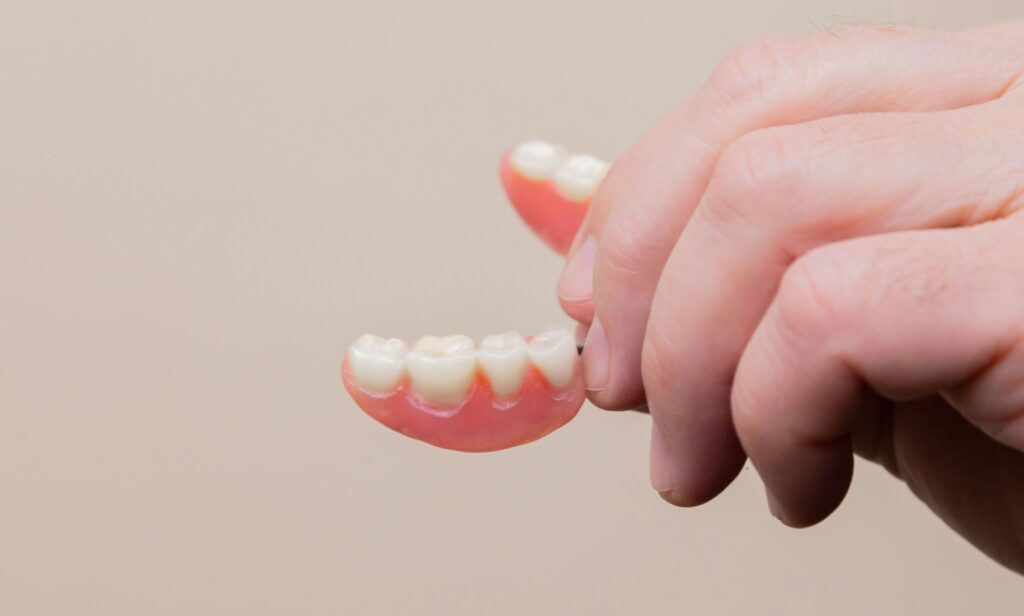
Although both options replace missing teeth, the way they function is quite different.
Dentures sit on top of the gums and are removable. They rely on the shape of the gums and sometimes neighbouring teeth for support.
Dental implants are fixed in the jawbone. They act as artificial roots and remain permanently in place once healed.
Some other important differences include:
Stability
Implants feel very secure because they are anchored in the bone. Dentures may occasionally move slightly when eating or speaking, particularly lower dentures.
Bone preservation
Because implants replace the root of the tooth, they stimulate the jawbone and help prevent bone shrinkage. Dentures do not provide this same stimulation.
Maintenance
Dentures need to be removed and cleaned daily. Dental implants are cared for much like natural teeth with brushing, flossing and regular dental visits.
Treatment process
Dentures can often be made relatively quickly. Dental implants involve a surgical placement stage and a healing period before the final tooth is fitted.
Both solutions have their advantages, and the right option often depends on your individual needs.
Dentures can be an excellent solution for many patients. They’re often recommended when several teeth are missing, particularly if the surrounding teeth are not suitable for supporting bridges or implants. Full dentures may also be appropriate if all teeth in an arch have been lost.
Dentures can also be helpful if bone levels in the jaw are reduced, making implant placement more complex without additional treatment.
Many of our patients appreciate that dentures can restore a full smile relatively quickly and without surgery.
Dental implants are often considered when one or more teeth need to be replaced and the jawbone is healthy enough to support the implant. They are particularly beneficial for patients who would prefer a fixed solution rather than a removable appliance. As implants are anchored into the bone, they feel very secure when chewing and speaking.
Implants can also be used to support implant-retained dentures. In this case, a denture clips onto a small number of implants, giving it significantly more stability than a traditional denture.
For many of our Chatham patients, implants offer a long-term solution that closely mimics the feel of natural teeth.
There is no single solution that suits everyone. The most appropriate treatment depends on several factors, including:
• The number of teeth missing
• The health and density of the jawbone
• The condition of remaining teeth
• Your lifestyle and preferences
• Your long-term goals for your smile
During a consultation, your dentist will carefully assess your oral health and discuss the options available to you. X-rays or 3D scans may also be taken to evaluate the jawbone and help plan treatment.
From there, a personalised recommendation can be made to restore both comfort and confidence in your smile.
Missing teeth can affect much more than appearance. Eating favourite foods, speaking clearly and smiling freely are all part of everyday life.
The reassuring news is that modern dentistry provides excellent options for restoring your smile. Whether dentures or dental implants are the most suitable solution, the aim is always the same: helping you feel comfortable, confident and able to enjoy life without worrying about your teeth.
If you’re considering tooth replacement options, a consultation with our Kent team is the best place to start. Together, we can explore the possibilities and choose the treatment that works best for you.
Back to BlogSmil, Unit 69-70, Dockside Outlet Shopping Centre, Maritime Way, St Mary's Island, Chatham, ME4 3ED